When you own a house, it always seems to be something to do, inside or…
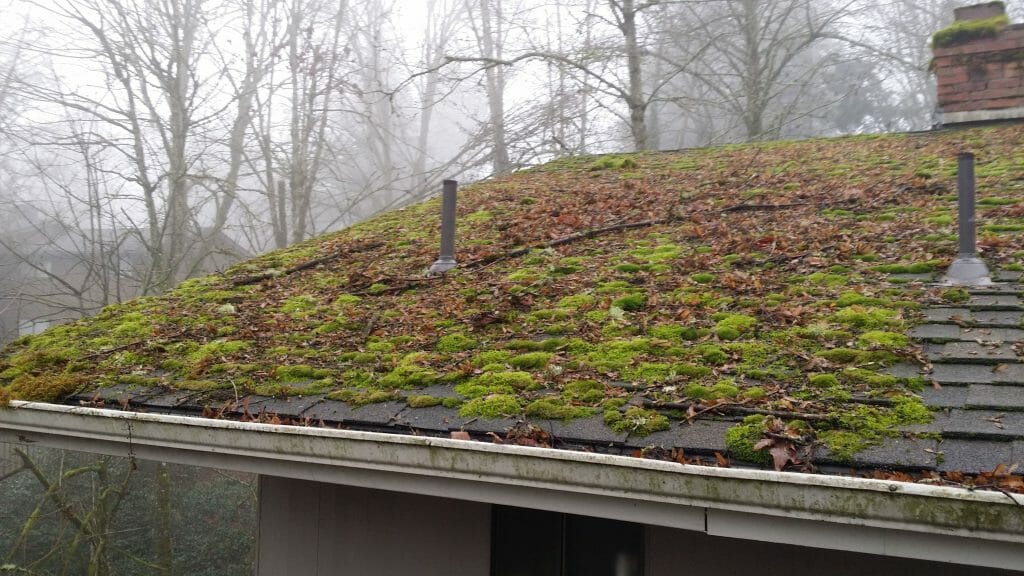
If you don’t know the answer to this question, you’re not alone. We get asked daily by homeowners and renters about things that are on their roof but shouldn’t be, including chunky green moss, lichen, black streaks, and their kids’ frisbee. And every day we help our clients solve these issues (including the frisbees!).
The short answer: moss comes off a roof one of two ways — physical removal or chemical treatment — and on an asphalt shingle roof, the chemical route is almost always the safer choice. Here’s how each works, what to avoid, and how to tell whether this is a job you should take on yourself.
Why moss is worth removing
Moss isn’t the same problem as the black streaks you may have seen on other roofs. Those streaks are a bacterium (Gloeocapsa magma), and the roofing industry generally treats them as a discoloration issue. Moss is different, because it’s structural.
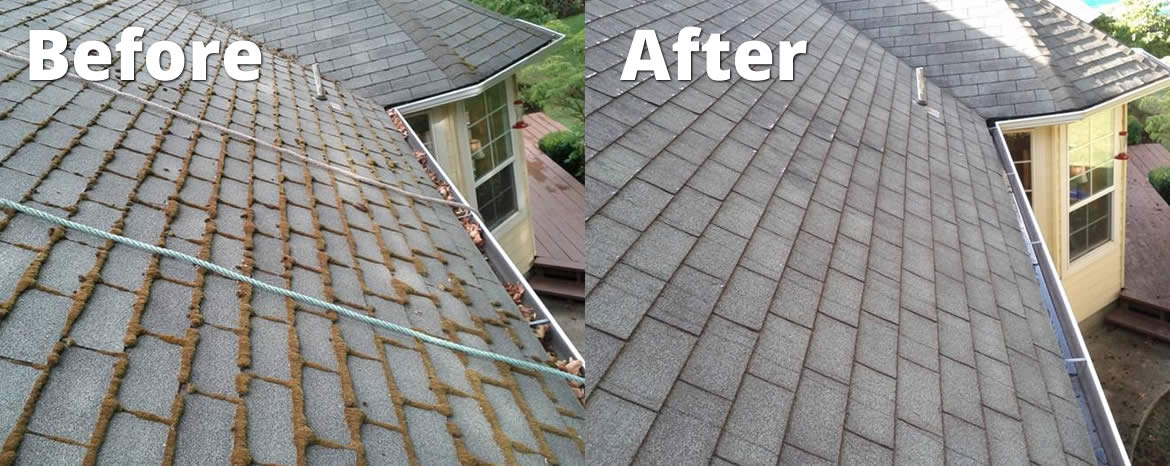
Moss holds water. Its rhizoids — the root-like structures that anchor it — grip the shingle surface and keep moisture against it long after the rest of the roof has dried. Over time, thick growth can work its way under shingle edges and lift them, which is how water finds its way to the decking underneath. That’s the real reason to deal with moss: not because it looks bad, but because a shingle that stays wet and a shingle that gets lifted are both doing a worse job than they should.
One honest caveat before you start planning: the Asphalt Roofing Manufacturers Association (ARMA) notes that the effects of roof cleaning are temporary and that growth is likely to recur. Removing moss is maintenance, not a permanent fix.
The two ways to get moss off a roof
1. Physical removal
This means agitating the moss loose — with a brush, a rake, or in some cases a pressure washer. It’s best suited to large, chunky growth, and it must be done with care, because the same force that dislodges moss can dislodge the roof.
Where it’s appropriate depends heavily on what your roof is made of. Tougher surfaces like metal and concrete tile tolerate agitation reasonably well. Asphalt shingle is a different story. ARMA’s guidance on asphalt roofs is explicit — don’t use a power washer, and don’t use a brush or broom either, because the friction can loosen and remove granules. (Worth knowing: CertainTeed’s consumer guidance does allow gentle brushing with a soft-bristled broom, so the two sources disagree. If your roof is asphalt and still under warranty, follow whichever your manufacturer publishes.)
Those granules are the shingle’s sun protection. Once they’re gone they don’t come back, and losing them ages the roof.
2. Chemical treatment
This is the method the industry generally points to for asphalt roofs, and it’s what we use. A cleaning solution kills the growth, and the dead material either rinses away gently or weathers off over the following weeks.
ARMA’s published recommendation for asphalt shingle roofs is a 50:50 mix of laundry-strength liquid chlorine bleach and water, applied with a sprayer, left to dwell for 15 to 20 minutes, then rinsed thoroughly with low pressure water. Other chemistries used on roofs include trisodium phosphate (TSP) and sodium percarbonate. Chemical treatment is also what handles lichen — the crusty gray-green patches that physical removal tends to just smear — and it can be used after physical removal to kill any remaining roots and spores.
The key point is that the chemistry does the work, so the pressure doesn’t have to. That’s what makes it lower-risk for the roof.
What NOT to do
- Don’t get on the roof unless you’re trained on roof and ladder safety. This is the big one. The U.S. Consumer Product Safety Commission estimates more than 164,000 emergency-room-treated ladder injuries a year, and a roof with wet moss on it is extremely slippery. ARMA’s own position is that only trained professionals should be doing this work.
- Don’t pressure wash an asphalt shingle roof, and don’t use wire brushes on one. This dislodges granules and takes years off the life of the roof. GAF, CertainTeed and Owens Corning all advise against power washing shingles.
- Don’t apply roof chemicals without protecting what’s below. Several are harmful to plants and animals. Landscaping needs to be pre-soaked or covered before you start and rinsed afterward, which realistically takes a second person on the ground.
- Don’t assume it’s a quick job. If what you see up there looks like a putting green, you should NOT plan any golf outings this weekend — you’ll be spending it on the roof.
Keeping moss from coming back
Two things genuinely extend the interval between cleanings.
Trim back overhanging branches. Moss needs shade and steady moisture. More direct sun on the roof means it dries faster after rain, and faster drying means slower regrowth. This is the cheapest, most effective thing most homeowners can do, and it doesn’t involve getting on the roof.
Keep the gutters flowing. Gutters that overflow keep the roof edge permanently damp, which is exactly the condition moss wants.
You’ll also see zinc or copper strips recommended for this — metal ions wash down the roof when it rains and inhibit growth below. The mechanism is real, but it’s worth knowing that ARMA specifically advises against retrofitting strips to an existing roof, because installing them means either exposed nails (which can leak over time) or breaking the shingle sealant bond. ARMA’s position is that strips make sense at roof replacement, not as an add-on. If someone offers to install them on your existing roof, that’s the trade-off you’re accepting.
Should you do this yourself?
Plenty of people do, and if your roof is low-pitch, walkable, dry, and you own proper fall protection, chemical treatment from a ladder is within reach for a careful DIYer.
We’d suggest calling someone if any of these apply:
- The pitch is steep enough that footing is a question. If you’re unsure, that’s your answer.
- The moss is thick and well established. Deep growth has worked into the shingle surface, and getting it off without damaging what’s underneath takes judgment about how much force is too much.
- You can see missing, curled, or bare shingles. The roof has a problem that cleaning won’t fix, and it should be looked at before anything else happens to it.
- There’s landscaping directly below the work area. Runoff management is most of the job on a planted lot.
- You’d be working alone. Nobody should be on a roof without a second person on the ground.
On cost, if you’re weighing DIY against hiring out: Angi puts the national average for professional roof cleaning at around $461, and soft-wash service typically runs higher than that. The number for any specific roof depends on size, pitch, how established the growth is, and how much protection the landscaping needs — which is why an on-site look is the only way to quote it honestly.
Of course, you could always just call the professionals at Clearly Amazing and let us handle the moss removal and other roof cleaning needs, so that you can keep your feet on the ground and spend more time with your family and friends. Estimates are free and we’ll tell you if we think the roof needs a roofer rather than a cleaner.
Related Posts