
Gutter Cleaning in Ashburn, VA

"*" indicates required fields
At Clearly Amazing, we take on all of the mess and risk so you don’t have to.
RESIDENTIAL SERVICES
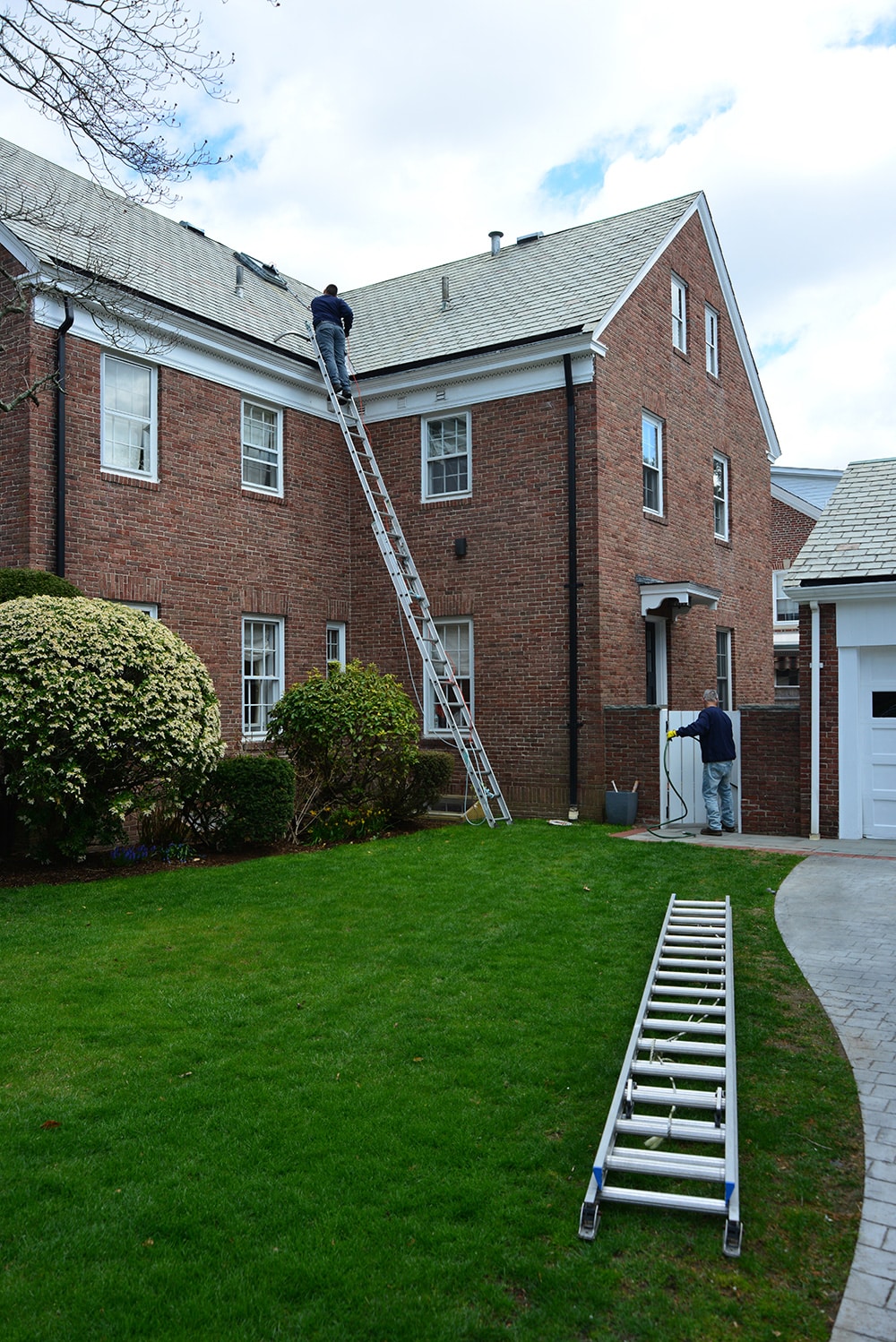
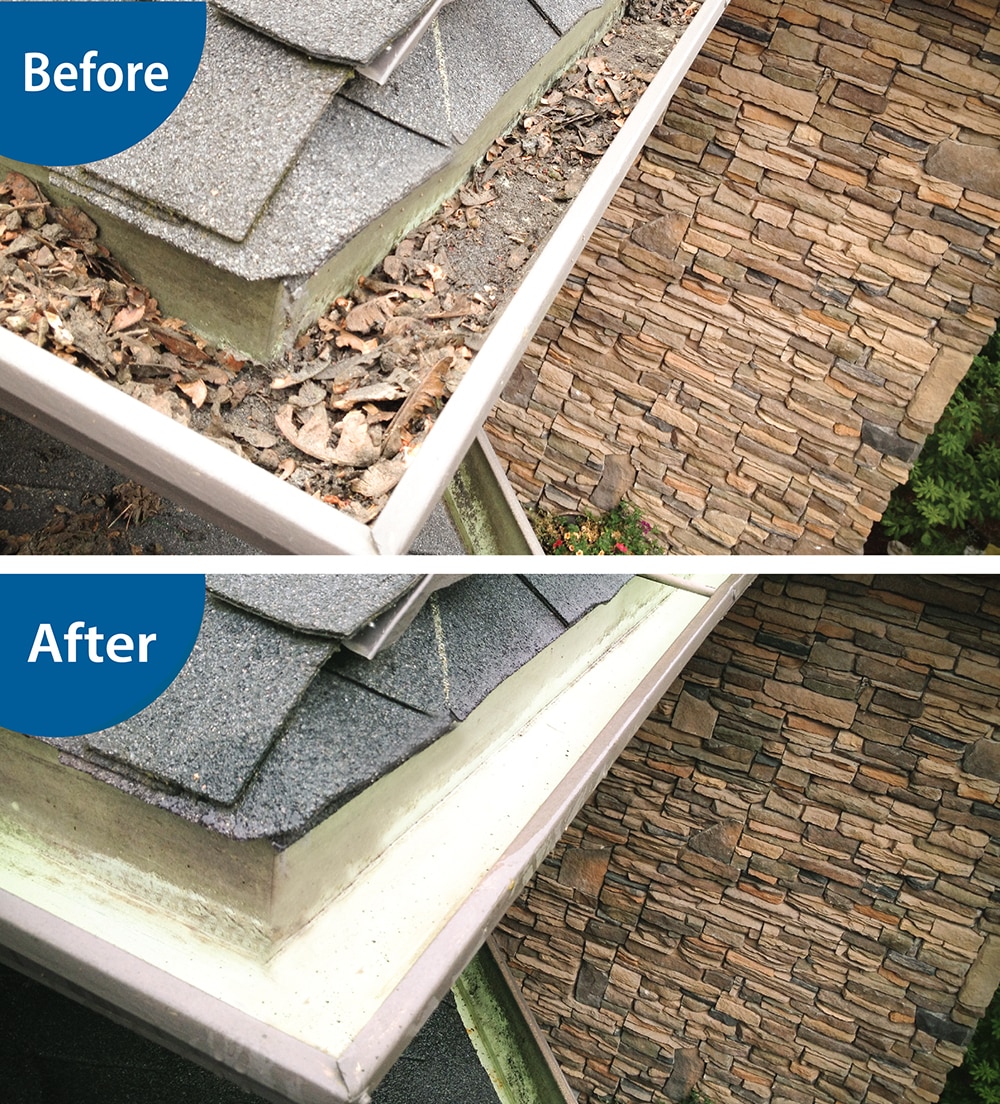
Clearly Amazing cleans gutters across Ashburn and eastern Loudoun County, from our Northern Virginia office on Trade Center Place in Sterling. Cleared by hand, bagged, carried away, every downspout flushed and watched. The thing that surprises people here is timing: Ashburn’s trees went in with its subdivisions, and many have only recently grown tall enough to reach over a roofline. Gutters that gave nobody trouble for years start behaving differently.
Call (703) 723-7770 for a free on-site estimate.
Ashburn’s trees have caught up with its roofs
This was farmland. Ashburn was known historically as Farmwell and stayed agricultural until the opening of Washington Dulles International Airport in 1962 started the shift. The suburb people live in now is recent: the 1990 census counted 3,393 residents, the 2020 census counted 46,349. Ashburn Village opened in 1987, Ashburn Farm followed in the same era, and buildout has continued through every decade since.
The consequence for gutters is not obvious until you have lived here a while. Landscape trees planted around a house in 1990 were irrelevant to the roof for their first fifteen years. They are not now. A homeowner who cleaned once a year without incident through the 2010s can find the same schedule stops holding, because the canopy changed even though the gutters did not. Newer sections of Ashburn sit earlier on the same curve.
What comes down depends on species, and Loudoun County is oak country. White oak, swamp white oak, chestnut oak and post oak are the four most common oaks here. Tulip poplar, the tallest native hardwood in Virginia at well over 100 feet, co-dominates the region’s mixed hardwood forest. As a general regional pattern rather than an Ashburn measurement, that mix behaves like this:
- Oaks drop leaf litter and acorns from September into November. Acorns are the problem child of gutter debris because they do not break down. They roll along the trough to the outlet and pack the downspout throat solid.
- Tulip poplar drops large leaves plus woody, cone-shaped seed pods that behave more like hardware than leaf litter.
- Tulip poplar again, in summer, sheds an aphid honeydew that feeds sooty mold on whatever sits below. In a gutter it binds loose debris into a mat that will not flush.
October is the wettest month and the heaviest drop month
Those two facts collide, and the collision is the argument for getting the timing right. October is the wettest month of the Ashburn year at roughly five inches, against a February low near two and a half, and it is the middle of the oak drop. The gutter carries its heaviest water load in the same weeks it takes on its heaviest debris load. A run that copes fine with a summer thunderstorm can overflow in a steady October rain because the outlet is packed with acorns.
Then winter arrives. Ashburn averages around 21 to 22 inches of snow a year, and the county winter average sits near 35 degrees with daily swings from the mid-20s to the upper-40s. That is water freezing and thawing repeatedly in whatever sits in the trough, and wet packed debris plus ice is a considerable weight hanging on fasteners and fascia specified for water.
Call (703) 723-7770 for a free on-site estimate in Ashburn, or request one online.
Areas we cover in Ashburn
Ashburn Village, with its 5,000-plus residential units, and Ashburn Farm, noted for its mature trees and established landscaping, are where the canopy question bites hardest. Broadlands, described locally as a tree-lined suburb, is similar. We also cover Brambleton, One Loudoun, Loudoun Valley Estates and Belmont Country Club, plus the wider Loudoun and Fairfax County area we work from Sterling.
When to schedule in Ashburn
Late November or early December is the slot that does the most work here. The oak drop has finished by then, the acorns are already in the trough rather than still in the tree, and the system goes into the freeze-and-thaw months clear.
Late spring or early summer is the useful second visit, and it is a different job from the autumn one: poplar seed pods and spring storm debris, cleared before the summer honeydew mats it all together.
One visit or two is a real distinction in Ashburn rather than a sales line. Under established canopy in Ashburn Farm or the older streets of Ashburn Village, two is usually right. In newer sections where the landscaping is still small, the late-autumn visit covers it comfortably.
Any other month is a perfectly good time to book. People call because they are selling, because water came over the front edge in a storm, because they got a note about staining on the fascia, or because they would rather not go up a ladder in January. Every one of those is worth doing.
Questions Ashburn customers ask
My house is barely twenty years old. Do I really need this yet?
Age of the house is the wrong measure; age of what grows over it is the right one. A 2005 house with a 2005 planting scheme has trees at roof height now. If nothing overhangs your roof, your gutters may genuinely stay clear, and we would rather tell you that than sell you a visit.
I have gutter guards. Is this still a thing I have to do?
Less often, but yes. Guards handle whole leaves well. Acorns and poplar pods tend to sit on top and block the openings rather than shedding off, and the summer honeydew film binds fine grit onto the mesh. Guarded systems mostly need the guards cleaned rather than the trough dug out, which is the lighter job.
Can I do it myself?
On a single-story section with someone footing the ladder, reasonably. The honest number to weigh is that the U.S. Consumer Product Safety Commission estimates more than 164,000 emergency-room-treated ladder injuries a year. The other consideration is the back elevation, which on a lot of Ashburn houses is the one over a deck or against a fence line with nowhere flat to set a ladder.
Water pools next to my foundation after heavy rain. Is that a gutter problem?
Sometimes it is a discharge problem, and an extension carrying the outlet a few feet further out solves it. Sometimes the gutter is overflowing upstream and the water never reaches the downspout at all. We flush and watch every outlet, so we can usually tell you which one you have.
Do you take the debris away?
Yes. It leaves bagged and it leaves with us, not into your yard waste bin, a common area, or the space behind the garage.
Clearly Amazing — Northern Virginia
43676 Trade Center Place, Suite 140, Sterling, VA 20166
(703) 723-7770
Request a free estimate · Gutter cleaning across Northern Virginia · How our gutter cleaning works