How long gutter cleaning takes depends mostly on your house: how tall it is, how…
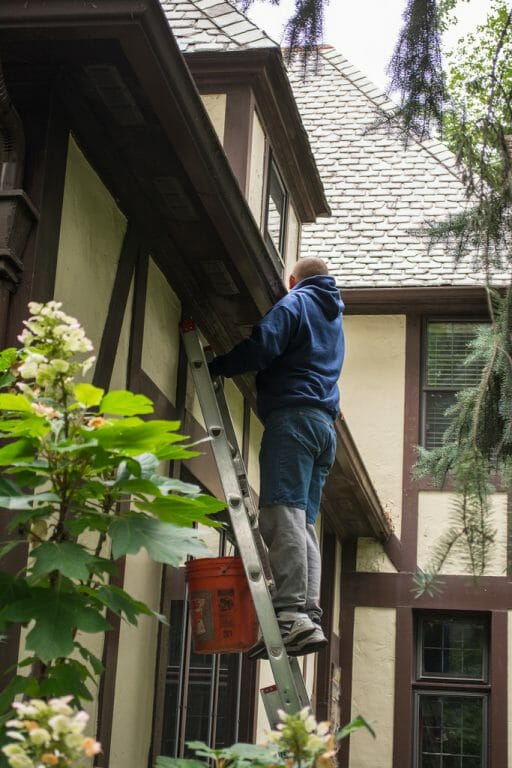
Gutter cleaning is ladder and roof work, so before you hire someone it’s worth knowing who pays if something goes wrong. If a worker falls, or a ladder goes through a window, or a neighbor’s car gets dented, the answer depends largely on the insurance the gutter company carries. That’s why gutter cleaning insurance matters to you as the homeowner, not just to the business.
This guide covers two things: what you could be responsible for if there’s an accident at your house, and how to check a gutter company’s insurance before you hire them. It usually comes down to one document and one phone call.
What you could be responsible for if someone gets hurt at your house
Two kinds of things go wrong on a gutter job. Someone gets hurt, or something gets damaged: your siding, your landscaping, a neighbor’s property, or a person walking by.
Injuries are the bigger worry, because this work happens on ladders and roofs. The CDC reported that in 2011, work-related ladder falls in the U.S. caused 113 deaths and an estimated 34,000 injuries treated in emergency rooms. Most jobs finish without a problem, but when one doesn’t, the costs can be large.
If the gutter company carries workers’ compensation, an injured employee’s medical bills and part of their lost wages normally go through that policy. If it doesn’t, the bills don’t disappear. The New Hampshire Insurance Department puts it plainly: if a contractor has no workers’ comp and a worker is hurt on your property, you could be held responsible for medical expenses, lost wages and related legal costs. Massachusetts’ Department of Industrial Accidents says homeowners can be held liable if a contractor working in their home gets injured, depending on the circumstances.
Whether that actually happens to you depends on your state’s laws and the details of the accident. The point is that it’s possible, and it’s avoidable.
Won’t my homeowners insurance cover it?
Maybe partly. It’s not something to count on.
A standard homeowners policy includes personal liability coverage, which pays when you’re legally responsible for someone’s injury or for damage to their property, and “medical payments to others” coverage for people hurt on your property with your permission. Both have limits and exclusions. One exclusion in the standard HO-3 form is for injuries to anyone owed workers’ compensation benefits that you provide or are required to provide. That’s uncommon when you hire a company, but it matters if your state ends up treating you as the worker’s employer.
Property damage can have its own gap. New Hampshire’s insurance regulator notes that many standard homeowners policies in that state exclude or limit coverage for damage caused by contractors.
Ideally, when a contractor’s work causes the loss, the contractor’s insurance handles it instead of you and your policy. Every policy is different, so if you want to know exactly how yours would respond, your insurance agent can tell you.
Do gutter cleaners need insurance?
From a homeowner’s point of view, yes. Legally, it depends on the state and on whether the company has employees. Two types of coverage matter.
- General liability. This covers bodily injury and property damage caused by the company’s work, plus legal defense costs. It’s what pays if a ladder goes through a window, a downspout falls on a car, or a passerby trips over a hose. Every gutter company you consider should have it.
- Workers’ compensation. This covers the company’s own workers if they’re hurt on the job. It’s the coverage that usually keeps an injured worker’s bills from becoming your problem.
Workers’ comp rules are set state by state, which is why you’ll hear different answers. New Hampshire requires it for contractors with one or more employees. In Texas, private employers can choose not to carry it at all. And in Minnesota, for example, certain business owners aren’t required to cover themselves. So a one-person gutter company without workers’ comp isn’t automatically cutting corners, but it’s worth knowing that, if the owner falls off your roof, there is no workers’ comp policy to handle it.
One more thing people mix up: a license and insurance are separate. A licensed contractor isn’t automatically insured. Check insurance on its own.
How to check a gutter company’s insurance before you hire
- Ask for a certificate of insurance. A certificate of insurance (often called a COI) is a one-page summary of a company’s policies. Ask for it to be sent to you directly from the company’s insurance agent or insurer, not forwarded as an old PDF. “We’re insured” over the phone isn’t proof.
- Read it. Check that the business name matches the company you’re hiring, that the policy dates cover the day of your job, and that general liability is listed. Look for workers’ compensation too. If it’s missing, ask why. On the standard certificate form there’s also a box showing whether the owners are excluded from the workers’ comp policy.
- Look at the limits. New Hampshire’s insurance department cites $1,000,000 per occurrence and $2,000,000 aggregate as a commonly recommended minimum for general liability. Your HOA or property manager may have its own requirement.
- Call the insurer or agent listed on the certificate. Don’t skip this one. The standard certificate form says on its face that it’s issued “as a matter of information only,” and a policy can be canceled or lapse after the certificate is printed. A short call confirms the policy is still active.
- Use your state’s lookup if there is one. Some states let you check online. In Washington, for example, the Department of Labor & Industries’ Verify tool shows whether a business has an active workers’ comp account.
- Ask about subcontractors. If the company sends someone else to do the work, that crew should be insured too.
- Keep a copy. Save the certificate and any emails about it. If something happens months later, you’ll want them.
If you manage an HOA, a condo association or a commercial property, you may want to be named as an additional insured on the company’s liability policy, which can make their insurance respond first if a claim comes up. Be aware that a note on the certificate isn’t enough by itself. The certificate form states that additional insured status has to be in the policy or added by endorsement, so ask the agent to confirm it.
Be cautious if a company won’t give you proof of insurance, or tells you insurance isn’t necessary for a job this small. Either one can be a sign of a gap in coverage.
A few more questions worth asking
Insurance is the big one, but it isn’t the only thing that keeps a gutter job safe.
- Do they bring their own equipment? A crew should arrive with everything it needs to work safely from a ladder or the roof. If someone asks to borrow your ladder, that’s a sign they aren’t set up for the job, and it puts your equipment in the middle of any accident.
- Have they worked on a roof like yours? If your roof is slate, tile or cedar shake, it’s fair to ask how much work they’ve done on that kind of roof.
- Can they give you references? Especially if you’re a business or an association with a reputation to protect.
Hiring an insured gutter cleaner
Clearly Amazing’s technicians are fully insured, with general liability and workers’ compensation covering every crew. A certificate of insurance is available upon request. You can read more about how we handle gutter cleaning, or request a free estimate and we’ll send you a quote.
Gutter cleaning insurance FAQ
Do gutter cleaners need insurance?
Whether it’s legally required depends on your state and on whether the company has employees. For you as the homeowner, a gutter cleaner should carry general liability insurance at a minimum, and workers’ compensation if anyone other than the owner will be on a ladder at your house or on your roof.
Why is gutter cleaning insurance important?
Because the work happens on ladders and roofs, where accidents can be serious. When a gutter company is properly insured, its policy is normally what handles those losses. When it isn’t, the costs can land on you.
What are the risks of hiring a gutter cleaner without insurance?
If a worker is hurt, you could be asked to cover medical bills, lost wages and legal costs, depending on your state. If the crew damages your home or a neighbor’s property, there may be no policy to pay for it, and your own homeowners insurance may exclude or limit that kind of claim.
What happens if a gutter cleaner falls at my house?
If the company carries workers’ compensation, the worker’s claim normally goes through that policy. If it doesn’t, the worker may look to you, and your homeowners policy may not cover all of it. The details depend on your state’s laws and your policy.
How can I check that a gutter company is insured?
Ask for a certificate of insurance sent directly from their insurance agent, check the business name and policy dates, then call the agent or insurer listed to confirm the policy is active. Some states, like Washington, also have online lookups for workers’ comp coverage.
This article is general information, not legal or insurance advice. Coverage and state laws vary, so check your own policy with your insurance agent.
Related Posts